Major William Erving
William was John and Abigail Erving's second
son, born in Boston on 8 September 1734.(1) He was Harvard educated and made
his career in the British Army before the Revolutionary War. He pursued
scientific study throughout his life, and endowed a chair in Chemistry at
Harvard, which continues to this day.
Lest we take him to be the perfect intellectual,
Harvard records show William was fined for playing cards and missing church
services. Friendships made at Harvard would endure; Oliver Wendell (listed
below) continued his relationship with the Ervings, and served as an Executor for
the wills of both William, and his father, John. (2)
Graduation list published
23 July 1753 (3)
William continued his
education, but was absent from his "second degree" ceremony at
Harvard because he was "gone to the expedition against Crown
Point." He was known as a military engineer. His career took him to
the second battle of Louisburg-now Cape Breton Island-and he was with General
Wolfe at the British victory at Quebec in 1759.(4) The surrender of
the French ended the French and Indian War in New England, but Britain's Seven
Years War continued. William participated in the siege of Havana in 1762.
Most of the portraits that depict
the second generation of Ervings were painted at the time of their marriages. In
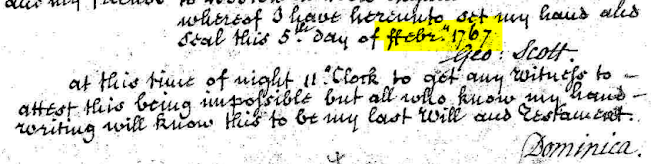
his will, William states, "whereas I have never been married and so of
course have not benefitted society by adding to their number.” If he sat for a
portrait, its disposition is unknown.
William requested a grant of land for his
military service, which was defined in June of 1775. He received 4,368 acres
and 3 rods in northern New Hampshire from King George, through the Provincial
Governor of New Hampshire. The grant was subject to establishing a road and
settling three families, paying taxes, and growing hemp or flax on 10% of the
land. Timber suitable for ship’s masts would also be reserved for His Majesty’s
Navy.(5) The land is mountainous without a waterway
to transport lumber from the interior. During the Revolution, William was
unable to fulfill the terms of his grant. Although undeveloped, the land
is still unincorporated as Erving's Location in Coos County, just south of
present Dixville Notch. The population was recorded as 31 in 1920, but none
were enumerated in most other years of record. There are a handful of vital records
that indicate a birth or death in the grant.

Erving’s Location in
Northern New Hampshire
William may have sat out the war in New
Hampshire; he did not fight with the Continentals. He was reportedly jailed
briefly upon his return to Boston. The Massachusetts Legislature acted on his
petition on 8 February 1786 to "naturalize" William Erving as a
citizen of the Commonwealth, giving him all rights, liberties, and privileges
as if he had been present at the establishment of the government. (6)
He inherited his father's pew in the meeting
house upon John’s death in 1786. It was highly valued at $50 in William’s
estate filing.
William shared a love of science with his
brother-in-law James Bowdoin. James had been elected to the American Academy of
Arts and Sciences in its first year in 1780, and William joined in 1784.
William placed a series of newspaper notices for meetings of its Agriculture
Committee in Boston in subsequent years, serving as recording secretary. His brother
George Erving, who had moved to England as a Loyalist, was also elected to AAAS
in 1790.(7)
Bowdoin’s connections as Governor of
Massachusetts in the new republic benefitted his wife’s family. James provided
a letter of introduction to Benjamin Franklin in May of 1787, calling William “a
worthy sensible gentleman,”(8) and to George Washington, calling William, "a firm and Zealous friend to the rights and liberties of America." (9)
In 1790, he lived in Roxbury with 2 males and 2
females, all over 16. (10) These servants were named in his will: Ezra
Hayward and Perley Pollard, and Jemina and Grace Fuller. Each was granted a
year's wages upon his death: $7.16 for the women, $15.12 to Pollard and $23 to Hayward
for "two legacies."
William Erving died 27 May 1791. Although he had
inherited a sizable fortune from his father only a few years earlier, he did
not inherit his father’s longevity; William did not live to see his 57th
birthday. His simple Roxbury house was valued at only $20 in his estate
inventory, while the Marlboro Street home that he had inherited from his father
was valued at $1,350. With his furniture and kitchenware that are enumerated, the
inventory of his personal property included four wigs, and from his military
past, his gun and bayonet, two swords, and a pair of pistols. His scientific
tools included a compass, a spyglass, a thermometer and barometer, and "a
case of instruments." He valued education and had acquired a large
library. He willed a portion of the land he had inherited from his father, 120
acres in the Town of Wendell, to support a school there. He wrote, "Whereas I think it of
the highest consequence that Learning should be preserved among us for
fear from the great inattention threat that people will relapse into
a State of Barbarism." He also gave a lot to the Town to support a
minister. (11)
His funeral procession left from the home of his
sister, Sarah Waldo, to his burial at Kings Chapel on 30 May 1791. (12) He was buried with his mother and sister, Mary, as he had
requested in his will. The identification of his gravesite is simple:
THE REMAINS OF
MAJOR WILLIAM ERVING
ARE DEPOSITED
IN THIS
TOMB. (13)
_____________________________________________________________
Notes:
(1) Massachusetts, U.S. Town and Vital Records, 1620-1988, The Holbrook Collection, Boston 1716-1643, on line at Ancestry.
(2) Suffolk County probate files found at Ancestry.
(3)"Colonial Collegians,"
(4) Boston Post-Boy, 23 July 1753, image on line at AmericanAncestors.
(5) Provinceland State Papers of New Hampshire, vol. 24.
(6) Colonial Collegians
(7) The many names can be found at
AAAS (8) American Philosophical Society, "Benjamin Franklin Papers Part 9, Letters to Franklin Mss.B.Finvetory85, XXXV, 58. Bowdoin, James on line at the
website (9) Colonial Collegians
(10) 1790 cnsus record
(11) Suffolk County probate files found at Ancestry
(12) Obituary
(13) "Documents of the City of Boston" Vol. 1, issues 1-23, 1914, p. 747, on line at Google books,